
What user generated content means on Instagram
User generated content, usually shortened to UGC, is any content made and shared by customers or fans, not the brand itself1. On Instagram that covers photos, videos, Stories, comments and reviews that reference or feature your product2.
So when a customer films a Reel unboxing your candle, posts a feed photo of your skincare on their shelf, or leaves a comment under your post saying the serum worked, all of that is UGC. The brand didn't make it. Didn't script it, didn't pay for it.
Organic, raw, paid and paid media UGC
Organic UGC is content customers make on their own, with no payment or partnership involved3. The word "organic" gets used two ways.
The first meaning is about money: organic means unpaid customer content, nobody paid anyone3. The second meaning comes from rate cards and creator briefs. There, "organic usage" covers the brand publishing the paid video on its own channels, with no ad spend behind it. "Paid usage" or "paid media UGC" works differently: the brand now pays to run that same video as an ad4.
A paid UGC creator can mimic the organic look. A brand still paid for the content, so it is not technically organic. Later defines a UGC creator as someone who produces content that "looks like organic UGC, but is actually paid for by the brand"3.
Raw UGC is the unedited file a creator hands over. It's the vertical video, the photo set, the voiceover, before your team cuts or captions it.
Hootsuite lists the usual handover: a short vertical clip, a batch of product shots, or a voiceover testimonial that your brand owns the rights to use4. Paid media UGC is that same content once you put ad spend behind it.
UGC costs nothing when it's organic, or a flat fee per asset when it's paid4. Control differs as much as cost: organic UGC is whatever a customer volunteers3, while a paid deal comes with deliverables you can name up front, like a vertical clip or a voiceover. Rates swing widely depending on format and usage rights, so settle both before work starts4.
| Label | Who pays | Where it runs | Rights needed |
|---|---|---|---|
| Organic UGC | Nobody | Customer's account | Permission before reuse off Instagram |
| Raw UGC | Brand | Delivered to brand | Agreed before work starts |
| Paid UGC | Brand, flat fee per asset | Brand's channels | Usage rights in writing |
| Paid media UGC | Brand, plus ad spend | Paid placements | Rights naming every placement |
Becoming a UGC creator without followers covers the full path.
UGC versus influencer content
Hootsuite's short answer: UGC creators produce content for your channels, while influencers post on their own4. That one difference decides where the money goes. Assets or reach.
With UGC, what you buy is the content plus permission to use it, not access to an audience4. With an influencer, you're paying for access to their audience. UGC work asks for neither a big following nor an on-camera face3.
| Aspect | UGC creator | Influencer |
|---|---|---|
| Posting channel | Brand's channels | Creator's own account |
| What brand buys | Content plus usage rights | Audience access |
| Follower requirement | No large following needed | Audience access is the point |
Pick a UGC creator when you need assets for your own feed, ads and product pages. Pick an influencer for their audience. You can find UGC creators yourself through a marketplace like Fiverr or Upwork4.
Can a brand reuse a post that tags it?
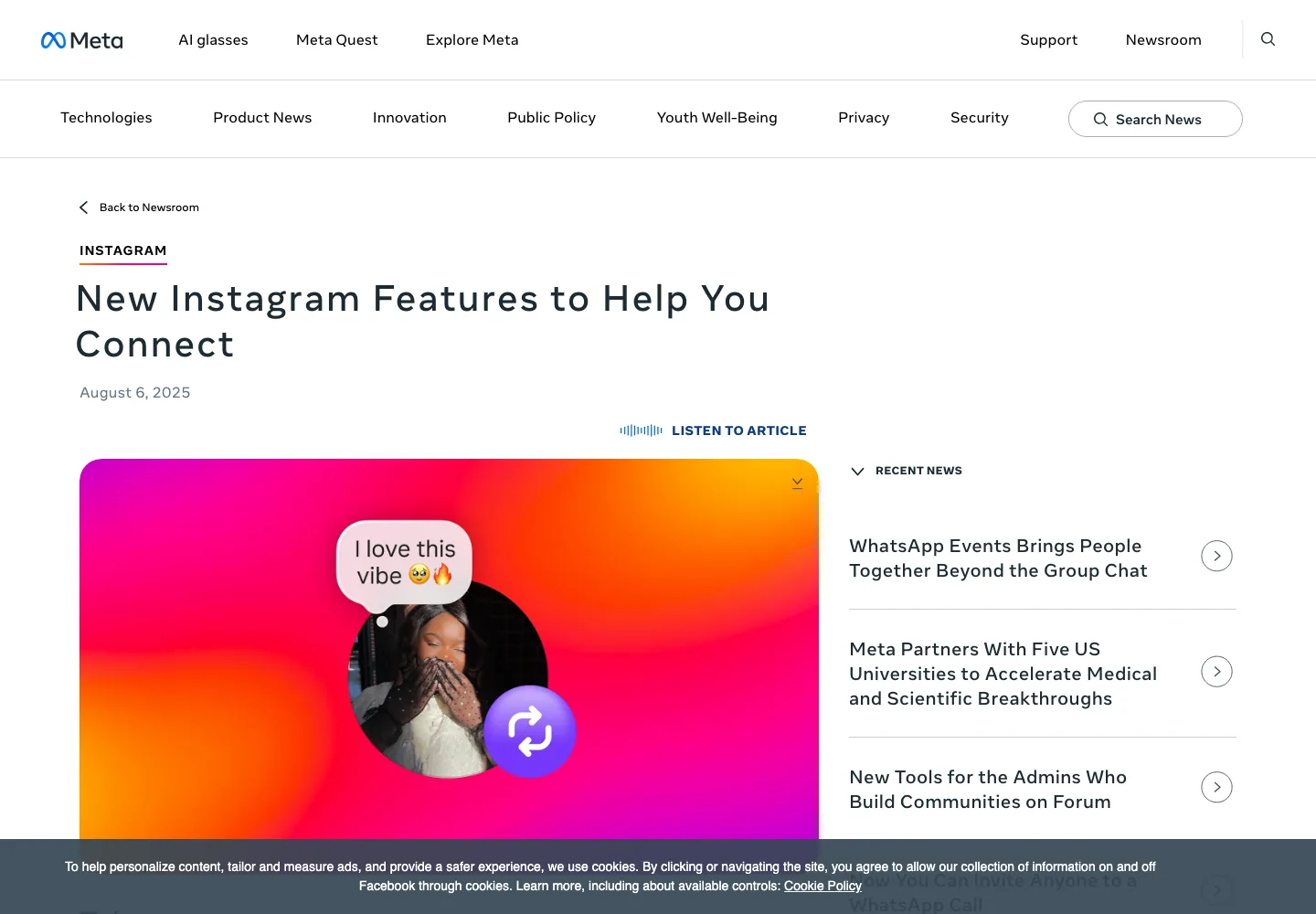
Instagram launched a native repost button on August 6, 2025, and it works on public Reels and feed posts. Reposts are credited to the original poster automatically. If you're a creator whose post gets reposted, Instagram may push it to the reposter's followers, including people who don't follow you, which gives you reach beyond your own audience. Reposts also sit in their own tab on the reposter's profile, and the reposter can add a note through the thought bubble on screen5.
A 2023 Insense guide said that mention and hashtag stickers let users "permit" the mentioned account to reshare the content6. That claim only holds inside Instagram, if it holds at all. The repost button applies to any public Reel or feed post, tagged or not5, and Curator treats the button as covering sharing inside Instagram only7.
So a tag does not hand your brand anything: it does not turn on the repost button, and it does not cover your website, your emails or your ads7. A tag is not permission. For any use beyond the button, get explicit permission first and credit the original creator27. Where appropriate, ask first and include terms about the user acknowledging the repost and the transfer of usage rights1.
The repost button covers sharing inside Instagram. Putting that post on your site, in an email or in an ad counts as a separate use. A comment reply or DM works as permission, as long as you keep a record7.
Save the reply. The practical process is to ask in the comments first, then lock in the details over DM and credit the creator's handle every time7.
| Use | Requirement |
|---|---|
| In-app repost | Repost button, automatic credit |
| Website or email | Creator's clear yes, recorded (comment reply or DM) |
| Paid ad | Creator's clear yes, recorded, with written terms naming the placement |
How to find and collect Instagram UGC
Start with the Tagged tab on your profile; it gathers every post that tags you7. Beyond that, watch your mentions and your branded hashtag, and run contests or submission prompts when you want volume.
Three named tools do the collecting for you. Later collects posts you've been tagged or mentioned in, but only on the Growth and Scale tiers; Starter is excluded3.
Its Contributors feature goes further. It lets outside people upload media straight into your Later account3. Juicer pulls posts from your branded hashtag or your Instagram account into one feed automatically1. Curator's Free plan is $0 a month. It allows 3 sources and a 1,000-post maximum8.
Once content is coming in, aim for consistency: at least 1 to 2 UGC posts a week worked into your content calendar2, which works out to roughly 52 to 104 UGC posts a year.
Three brand campaigns worth studying
Apple's #ShotOniPhone reposts photos shot by iPhone owners worldwide1. The product is the camera. Every customer photo is a demo.
LaCroix takes a different approach. Rather than leaning on branded hashtags or a roster of ambassadors, the brand regularly reposts content from everyday creators, no matter their follower count4. That's a useful model for a small brand, because it works with whatever your customers already post.
GoPro runs the Million Dollar Challenge: if your clip makes the highlight video, you get an equal share of $1,000,000. In the HERO11 Black + Mini round, the fifth in the series, 55 creators across 21 countries took home $18,181.81 each. Entries had to be uploaded to the GoPro Awards site or the Quik app by April 2, 2023, not posted with a hashtag9.
Where the trust stats come from
Consumers are 2.4x more likely to see user generated content as authentic next to brand-made content. Later links that figure to a Stackla release dated February 20, 2019, so it is about 7 years 8 months old3.
The purchase-impact stat has two versions. Check the dates. Later points to 80% of respondents who said UGC has a high impact on what they buy. That figure links to a socialmediatoday article, and the page never gives that article's date3.
Billo cites 79% of customers saying UGC strongly influences buying decisions, with no inline citation, and nothing in its Sources list shows which entry backs the 79%. Nosto's post from September 22, 2022 carries the title of the 2019 Stackla release, so it reworks that older survey rather than reporting 2022 data2.
The older number is Nielsen's Global Trust in Advertising survey from 2012, which predates the 2019 Stackla release and the later write-up of that survey. In it, 92% of consumers worldwide said they trust earned media, like recommendations from friends and family, over every other form of advertising. That survey reached over 28,000 internet respondents across 56 countries10.
Written terms for paid UGC
Every paid UGC deal needs the deliverables and the usage rights in writing before filming starts. Spell out what you're buying, whether that's the vertical clip, the product shots or the voiceover4.
Name each placement. Organic feed, paid ads, product pages and email are all separate uses, and your usage rights need to cover every one of them4.
Hootsuite says to always disclose paid UGC4, and Curator says to label paid partnerships clearly when you repost them7.
If the creators you hire sell on TikTok Shop, Rateful can manage that side. It's an AI manager built for creators on TikTok Shop, not an Instagram tool. You email the creator's handle@rateful.ai address, and Sam, the AI manager, negotiates against the creator's rate card and only accepts a deal with the creator's OK.
Rateful takes 0% of the creator's deals. Creators pay $0 until their first closed deal, then pick Pro at $49 a month, Scale at $149 a month, or the Free plan, where each of Sam's replies waits for the creator's approval.
For the paperwork side, grab the rate card with usage pricing, keep these brand deal counteroffer scripts handy for negotiation, and see the UGC platforms for brands compared if you're hiring rather than creating.
Questions people ask
What does raw UGC mean?
Raw UGC is the unedited source file a creator hands over, before any cutting, captions or brand styling. With a paid deal you also agree on format and usage rights before work starts. Typical files are a vertical clip, product shots or a voiceover4. Your team then edits them for each placement.
Is paid UGC still organic?
No. A paid UGC creator makes content that looks like ordinary customer posts, but a brand paid for it, so it is not technically organic3. The look can be organic. The money makes it paid.
Do you need permission to repost UGC on Instagram?
Inside Instagram, the native repost button shares public Reels and feed posts with automatic credit to the original poster5. Anything beyond that, like your website, an email or an ad, is a separate use and needs the creator's clear yes7.
How often should you post UGC?
Billo's guidance is to work at least 1 to 2 UGC posts into your regular content calendar each week2. Spread over a year, that's roughly 52 to 104 UGC posts.