
The short verdict
All prices here were checked on the Insense site on 2026-11-05, so treat them as a snapshot. Note the rating gap first: Insense holds 4.5 out of 5 on G2 across 374 reviews1, but sits at 3.6 out of 5 on Trustpilot, where a quarter of reviewers leave one star2, so read both.
How a campaign runs on Insense
The platform combines a creator marketplace, influencer outreach, creative briefs, direct chat and campaign management3. Insense says brands usually choose creators within 5 to 10 business days after creating a campaign4, so plan your calendar around that window.
You can work with TikTok Shop affiliates on videos, and turn top-performing creator content into Spark Ads. Creator content can also run as Meta Partnership Ads, with plans including 1, 10 or unlimited connections and five more available at $125 a month3. Once you hire, payment leaves your brand account and sits frozen on Insense's account. After you approve the content and the deal closes, the money transfers to the creator's Insense wallet inside the app4.
On rights, Insense's terms give your brand the full digital copyright to any content you commission3. One friction point: a G2 reviewer noted that creators are sometimes not aware of the lifetime usage terms, which can make negotiations awkward1. Spell usage out in the brief.
Plans, fees and add-ons
Insense sells three self-service plans, with prices checked 2026-11-05 on the Insense pricing page unless noted otherwise. For more detail, see the Insense 2026 pricing breakdown.
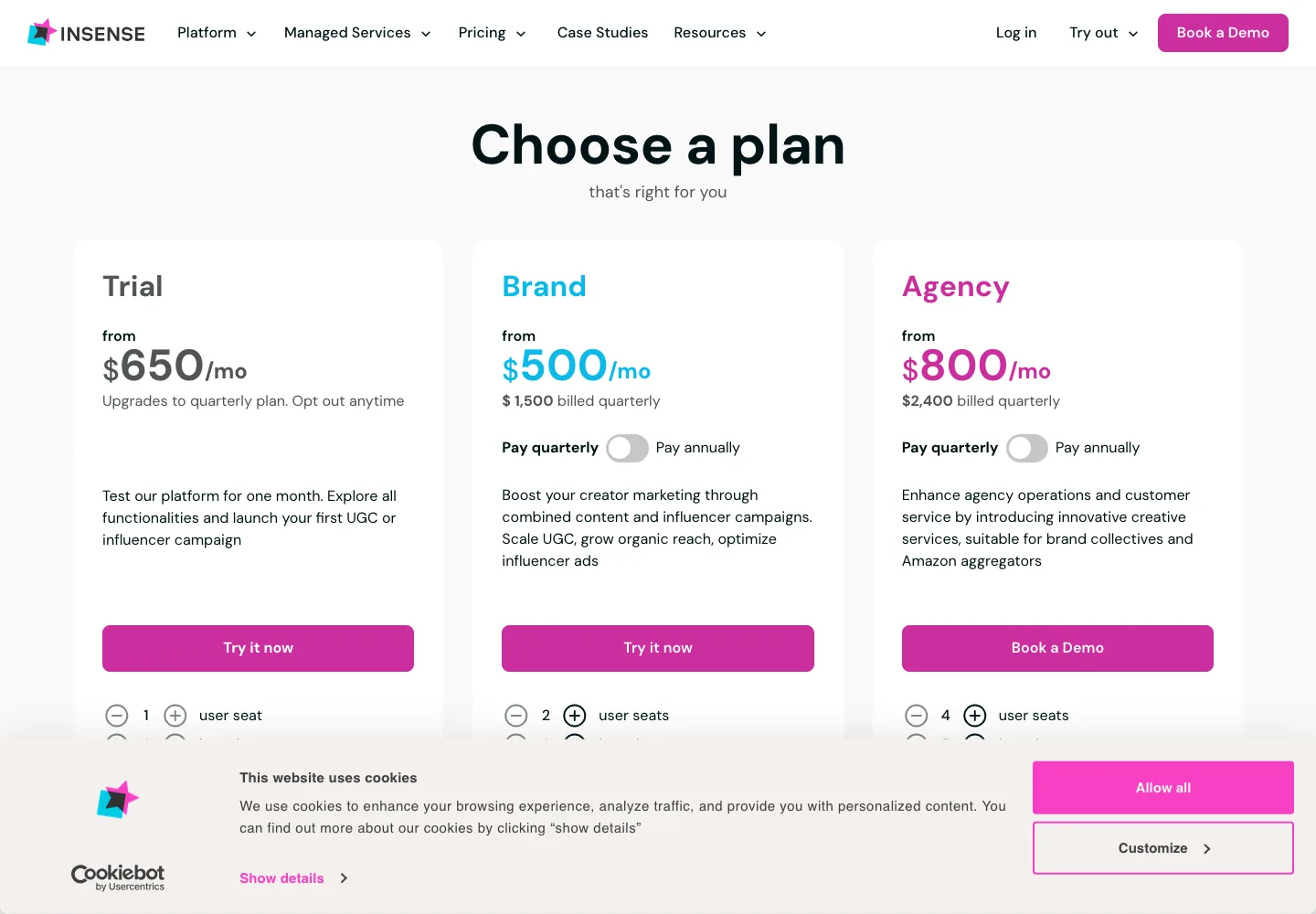
| Plan | Cost per quarter | Cost per year | Creator hires | Campaign limit | Seats included | Brand accounts | Partnership Ads connections | Marketplace fee |
|---|---|---|---|---|---|---|---|---|
| Trial | $650 (one month) | n/a | Up to 10 | 1 | 1 | 1 | 1 | 20% |
| Brand | $500 per month ($1,500 each quarter) | $400 per month ($4,800 per year) | Unlimited | Unlimited | 2 | 1 | 10 | 10% |
| Agency | $800 per month ($2,400 each quarter) | $640 per month ($7,680 per year) | Unlimited | Unlimited | 4 | 5 | Unlimited | 7% |
On Insense's own pricing page, Agency costs $2,400 when billed quarterly, and the annual option works out to $640 per month, or $7,680 per year. G2's vendor listing shows only $800 per month for Agency1. Trial limits you to one campaign and up to 10 creators. Brand and Agency have no such limits3.
Add-ons cost extra. Extra seats cost $30 a month and extra brand accounts cost $100 a month; five more Meta Partnership Ads connections cost $125 a month3.
Two things catch buyers off guard. First, creator pay is not included in any plan and must be budgeted separately, which surprises people. Plan for that, and note that a separate transaction fee is also added to each creator payment3.
Second, the fee numbers on the site are inconsistent. The pricing page describes the marketplace fee as covering "the 5-10% Payment Facilitation Fee, and the 5-10% Service Fee", while the FAQ describes 5% for payment facilitation plus 5% for admin. That 10% math conflicts with both the 20% Trial tier and the 7% Agency tier in the plan table3, so confirm the fee on the plan you pick before budgeting.
Brand and Agency subscriptions automatically renew every 3 months3. Older third-party reviews still list the Trial at $500 or $55056, while Insense's own G2 listing shows the Trial at $6501, and one ranking page cites a stale G2 review count of about 1606. Another review lists a retired UGC plan at $1,200 per quarter7; those prices are outdated.
Managed services
Insense also sells managed services: done-for-you work through its in-house creative team, covering strategy, UGC production and influencer seeding, with access starting after a demo3. Its managed-service pricing page does show starting prices.
The cost per video drops as the order grows, because the plan fee and marketplace fee are spread over more videos. Based on pricing published by Insense. Source: 3.
A Dedicated Platform Manager starts at $2,500 per month. The Ready-To-Go UGC videos package starts at $3,500 and includes 8 custom videos. Ready to go UGC Ads start at $2,800 for 6 ad assets8.
Third-party reviews report different figures. One lists a dedicated platform manager from $1,600 a month and a starter Package 1 priced at $2,800 monthly, which covers 6 UGC video ads6. Another cites about $2,900 for six ready-made videos and about $1,800 a month for an account manager5.
That's a wide spread. Get a quote.
What a video actually costs you
Per Insense, UGC video work starts at $100 for one video, and nano sponsored posts start at $1253. Your real cost for each video is the plan fee plus creator pay plus the marketplace fee, divided by videos delivered. For context on what creators charge outside marketplaces, check current TikTok Shop creator video rates.
The trial month is the expensive way to test. Ten videos at the starting rate: $650 plan + $1,000 creator pay + $200 fee (20%) = $1,850, or $185 a video. Forget to cancel and the trial auto-upgrades to Brand at $500 per month with quarterly billing3, which means $2,150 in platform fees (the $650 trial month plus the $1,500 first quarter) before any creator pay.
The Brand plan rewards volume. Take the first quarterly cycle: $1,500 plus $110 for each video (the $100 starting rate plus 10% fee).
- 3 videos: $1,830 total, $610 a video.
- 6 videos: $2,160 total, $360 a video.
- 15 videos: $3,150 total, $210 a video.
- 30 videos: $4,800 total, $160 a video.
- 60 videos: $8,100 total, $135 a video.
On the annual Brand plan, billing drops to $400 per month, or $4,800 per year, versus $1,500 billed each quarter3. At 120 videos a year that is $4,800 plus 120 x $110 ($13,200), or $18,000 in total, working out to $150 a video and saving $1,200 a year against quarterly billing.
The fee difference between plans adds up at scale:
| Plan | Fee on $1,000 creator pay | Agency break-even |
|---|---|---|
| Trial | $200 (20%) | n/a |
| Brand | $100 (10%) | n/a |
| Agency | $70 (7%) | n/a |
| Agency vs Brand | saves $30 per $1,000 | $30,000 per quarter with one brand; $20,000 with two |
The Agency plan costs $900 more per quarter than Brand, and the fee gap between Brand at 10% and Agency at 7% is 3 points3. With one brand, $900 divided by 3 points puts break-even at $30,000 of creator pay per quarter.
With two brands, Brand plus a $100 per month extra brand account runs $1,800 per quarter, so the gap to Agency shrinks to $600 and break-even drops to $20,000 per quarter3. Below that, Brand wins, so do the math first.
What reviewers actually say
Ratings differ sharply by source, and the difference tells you who is reviewing. Figures checked 2026-11-05.
| Source | Rating | Review count | Date checked |
|---|---|---|---|
| G2 | 4.5/5 | 374 | 2026-11-05 |
| Trustpilot | 3.6/5 | 192 | 2026-11-05 |
Creators pay nothing to use the Insense app, and after a brand signs off on the finished work, the funds land in the creator's in-app Insense wallet4. A July 2026 third-party review puts the iOS app at about 4.4 stars from around 1,200 reviews5. Treat that as a reported figure and re-read the current rating from the App Store listing before relying on it.
G2 skews positive, but several reviews carry "Incentivized" and "Seller invite" labels. The most common praise tags are ease of use (148 mentions) and setup ease (86)1. The top con theme is Brand Challenges (27 mentions), which users describe as non-payment and irrelevant collaboration offers9.
Poor customer support (26 mentions) and time delays (25) come next. If you need custom tracking, weigh that an enterprise reviewer called rigid trackers and reporting the platform's main limitation1.
Trustpilot skews negative and creator-heavy. Its TrustScore is 3.6 out of 5, rated Average, from 192 reviews. The star split is 55% five-star against 25% one-star, and Insense has replied to only 2% of negative reviews2.
The recurring complaints are mismatched campaign categories, low acceptance rates, restrictive deadlines and delayed communication from brands2. Treat Trustpilot as a window into the creator side of the marketplace. Unhappy creators there become an unhappy hiring pool for you.
The creator pool you are hiring from
Creators need at least 1,000 Instagram followers, 500 median TikTok views and 1% engagement to join. Insense's creator page lists 22 countries by name, including the USA, UK, Canada and Australia, yet claims "35+ countries" on the same page4.
Network size claims are equally inconsistent. The Trustpilot blurb says 75,500+ creators and 2,500+ brands2, while the G2 profile says 100,000+ creators1. The creator page claims $8M paid out since 2020 across 3,500+ brand partnerships4. Check the fine print.
Creators set and negotiate their own prices with brands, and the creator app is free with no hidden fees on their side4. If your product needs a very specific creator profile, run the trial's single campaign as a supply test before committing to a quarter, which keeps the first test small.
Who should buy it, and what to use instead
Pick Insense Brand if you run paid social and need a steady flow of UGC for Spark Ads, roughly 15 or more videos per quarter. Agency only pays off past the break-even points above. Pass on Insense entirely when a single month from $650 or quarterly billing clashes with how your company buys software3.
For a broader view, see the Insense alternatives for brands and the roundup of UGC platforms for brands.
For booking TikTok Shop creators directly, Rateful works the other way around. Brands email the creator's handle@rateful.ai address, and Sam, the creator's AI manager, negotiates against the creator's rate card and sends the agreement.
When the brand signs the agreement, it pays through Rateful via Stripe. On a creator's own deals, the creator receives a deposit ahead of filming, while Rateful keeps the balance back until the content is posted. The exact schedule is written into the agreement. The brand pays roughly 5% extra for booking protection, added to the deal amount and shown before payment, so a $1,000 deal lands at roughly $1,050 all in.
Every creator gets a public profile at rateful.ai/@handle listing their packages, latest videos and stats, and brands can book them straight from that page. Creators who want that setup can get started on Rateful. For a side-by-side look, read the Rateful vs Insense comparison.
Cancel at least 48 hours before your Trial ends, or the account moves onto Brand at $500 monthly on quarterly billing. Cancellation goes through email or the support chat, and your access stays open until the end of the current billing cycle3.
Set a reminder three days before the trial end date, not on the day. The 48-hour cutoff means a same-day cancellation attempt is already too late, and the renewal after that is a full quarterly commitment3. Act early.
Questions people ask
Is Insense legit for brands?
Insense is a real marketplace, and by Insense's own count it has 3,500+ brand partnerships and $8M paid out to creators since 2020. The independent signals are mixed. Once a creator is hired, your payment is taken from your account and frozen on Insense's account4. Ratings split between 4.5 out of 5 on G2 across 374 reviews1 and 3.6 out of 5 on Trustpilot2.
How much does Insense cost per month?
The Trial starts at $650 for a single month, Brand costs $400 to $500 monthly depending on billing term, and Agency is $800 monthly on quarterly billing or $640 monthly on annual billing31. Creator pay and the marketplace fee of 7% to 20% come on top of the plan price3.
Does Insense have a free trial?
There is no free trial. The Trial plan is a paid one-month package from $650, limited to one campaign and up to 10 creators. Unless you cancel 48 hours before it ends, it auto-upgrades to the quarterly Brand plan3.
What is the Insense marketplace fee?
It is a percentage added to creator pay. The rate is 20% for Trial, 10% for Brand and 7% for Agency. The FAQ describes it differently, as 5% for payment facilitation plus 5% for admin3, which conflicts with the plan-tier percentages. Confirm the fee on your plan before budgeting.
How do I cancel an Insense subscription?
Email Insense or use the support chat, and do it at least 48 hours before a trial ends to avoid the auto-upgrade. Your access continues until your paid billing cycle ends3.
What does it take to join Insense as a creator?
The entry bar is modest: 1,000 Instagram followers, 500 median TikTok views and 1% engagement. Joining costs creators nothing, and they set their own rates in each deal4.