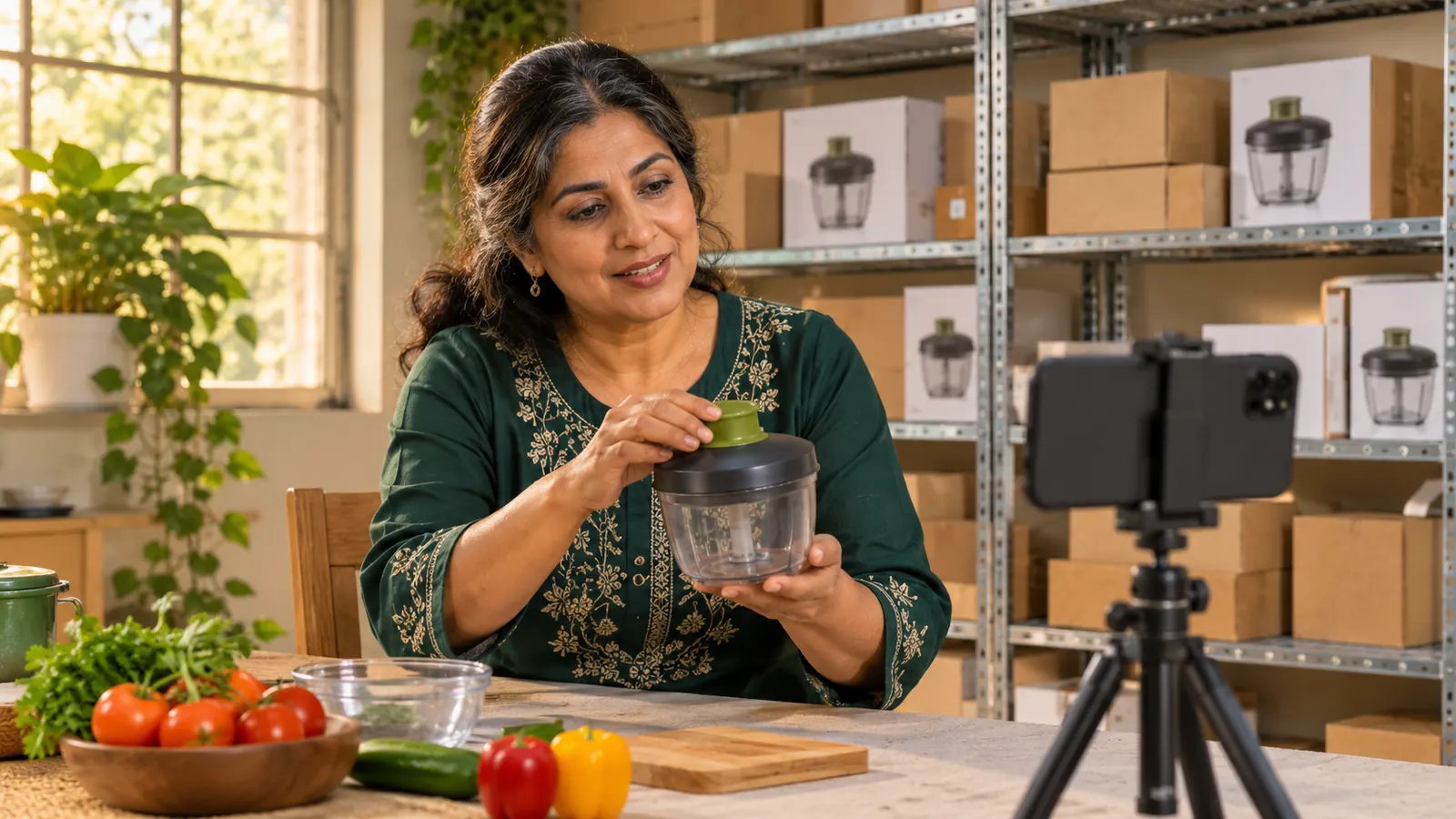
Rateful vs Agentio: the short answer
On Agentio the platform sets the price and the creator accepts or declines2; on Rateful you set the rate card, and Sam never accepts less.
The two solve different problems. Creators do not negotiate on Agentio, and the platform prices the inventory2. Rateful leaves pricing to you.
A creator active on both YouTube and TikTok could use Agentio for YouTube ad reads and Rateful for TikTok Shop deals.
Rateful vs Agentio at a glance
| Agentio | Rateful | |
|---|---|---|
| What it is | Marketplace where brands bid on creator ad units, mostly ad reads in videos1 | AI manager (Sam) for creators on TikTok Shop |
| Platforms | YouTube and Instagram, plus Meta Partnership Ads23 | TikTok Shop |
| Who sets the price | Agentio prices inventory from audience data; the creator says yes or no2 | The creator sets a rate card; Sam never goes below the minimum |
| Creator cost | Free for creators and managers2 | Nothing until the first deal closes, then Pro at $49 a month, Scale at $149 a month, or Free; 0% of deals |
| Brand cost | 20% Campaign Fee of the total budget; no published rate card14 | Booking protection of about 5% on top, shown before paying |
| When the creator is paid | Payments go through a payment provider, under the payment terms then in effect1 | The brand pays before filming; the creator's deposit is released before filming and only the rest is held until the posts are live |
| Minimum age | 13, with a parent or guardian agreeing for under-18s1 | 18 or older |
| Payout currency and region | US dollars1 | Stripe, United States only for now |
| How to join | Get started | About 60 seconds with a TikTok handle and an email |
Prices and terms in this table were checked on November 5, 2026, and Agentio's Terms of Service were last updated October 8, 2026, forming an agreement with Agentio, Inc.1.
For creators: price control, pay and the rules you sign
Agentio sends you offers with the rate, timeline and requirements already set, so there is no pitching, negotiating or invoicing. The price on each offer comes from your audience data and past brand campaigns, not from a conversation with the brand. It costs creators and their managers nothing2. A manager can only help after you open the account yourself1.
Agentio's creators tend to be large channels. Launchpoint reports an average of about 1 million subscribers and 100,000 views per video5.
Accepting a bid means agreeing to all of that brand's campaign requirements. Declined requests pay nothing1. So do canceled or unfulfilled ones.
If your post comes down within 10 business days after fulfillment, you refund the fees already paid. You also promise not to contact brands you met on Agentio except through it. Following FTC endorsement guidance, like labeling content "sponsored" or "ad", sits with you1.
On G2, Agentio holds 4.9 out of 5 from 75 reviews. A minority of reviewers mention limited offers restricting their options (6 mentions) and low rates with awkward negotiation (5 mentions)6.
Sam works the other way around. Brands email your deals address, handle@rateful.ai, and it replies. It negotiates to the rate card you set and never goes below your minimum. Nothing is accepted without your OK.
Every plan, Free included, runs a scam check on brand emails. Sam also pitches brands for you: 10 free pitches, unlimited on Scale. Rateful never posts or messages on TikTok for anyone. If you want the mechanics, see how an AI manager handles your brand emails.
Your plan decides what you keep. Say you close two $500 deals in a month (illustrative deal sizes, not an earnings promise; what you make depends on your rates and which brands say yes). Rateful takes 0% of the deals.
Pro leaves you $951 ($1,000 minus $49), Scale leaves you $851 ($1,000 minus $149), and Free keeps the full $1,000.
With Agentio, joining is free and you receive your accepted bid in full21. For rate benchmarks before you set yours, see what TikTok Shop creators charge for one video.
For brands: what you pay and what you get
On Agentio you bid on creator inventory, and the bid is CPM times the creator's historical median views. Contrary's example: 100,000 median views at a $40 CPM produces a $4,000 bid7. The brand also pays a Campaign Fee: 20% of the campaign's total budget, so the fee is part of that budget1.
No rate card is published4. Agentio also offers creator-led Partnership Ads on Meta3. Forerunner led Agentio's $40M Series B, announced November 18, 20258. For a full fee breakdown, see Agentio pricing 2026: the 20% fee, terms and who pays.
Budget for the license, not just the bid. During the license period you get an exclusive, worldwide, irrevocable license to the creator's ad. You may run it as paid advertising, not organic content, including on TikTok and Snapchat ad products1.
The license starts at first use, or 14 days after the creator approves it if that comes first. It renews in successive 30-day periods unless you or the creator ends it at least 5 days before renewal1.
Use the ad after the license ends and Agentio may charge the full bid plus Campaign Fees again for each license period of unpermitted use1, so note the license end dates when the deal closes.
For example, the creator approves the license on March 1 and you have not used the ad yet, so the license period starts March 15, 14 days later. It then renews monthly unless either side ends it 5 days or more before the next renewal1.
As a brand, you book a creator from their public page at rateful.ai/@handle, which shows their packages, recent videos and numbers. Sam sends a written agreement, you pay before the creator films; the creator's deposit is released before filming and only the rest is held until the posts go live. Booking protection, roughly 5% on top of the deal amount, is shown before you pay. If you want to see who else books creators this way, browse TikTok Shop brands that work with creators.
These numbers assume Agentio's 20% Campaign Fee sits inside your total budget, so the creator's bid is 80% of that budget19.
| Creator receives | Brand pays on Agentio | Agentio Campaign Fee | Brand pays on Rateful | Rateful booking protection |
|---|---|---|---|---|
| $500 | $625 | $125 | about $525 | about $25 |
| $1,000 | $1,250 | $250 | about $1,050 | about $50 |
| $2,500 | $3,125 | $625 | about $2,625 | about $125 |
| $5,000 | $6,250 | $1,250 | about $5,250 | about $250 |
Is the Agentio fee 20% or "not published"? what the sources say
Agentio's terms define the Campaign Fee as 20% of the total budget. They also say creators keep the full bid they accept1. microinfluencers.io says Agentio has not published this 20% figure on its site and describes the split as the creator getting 80% of brand spend9.
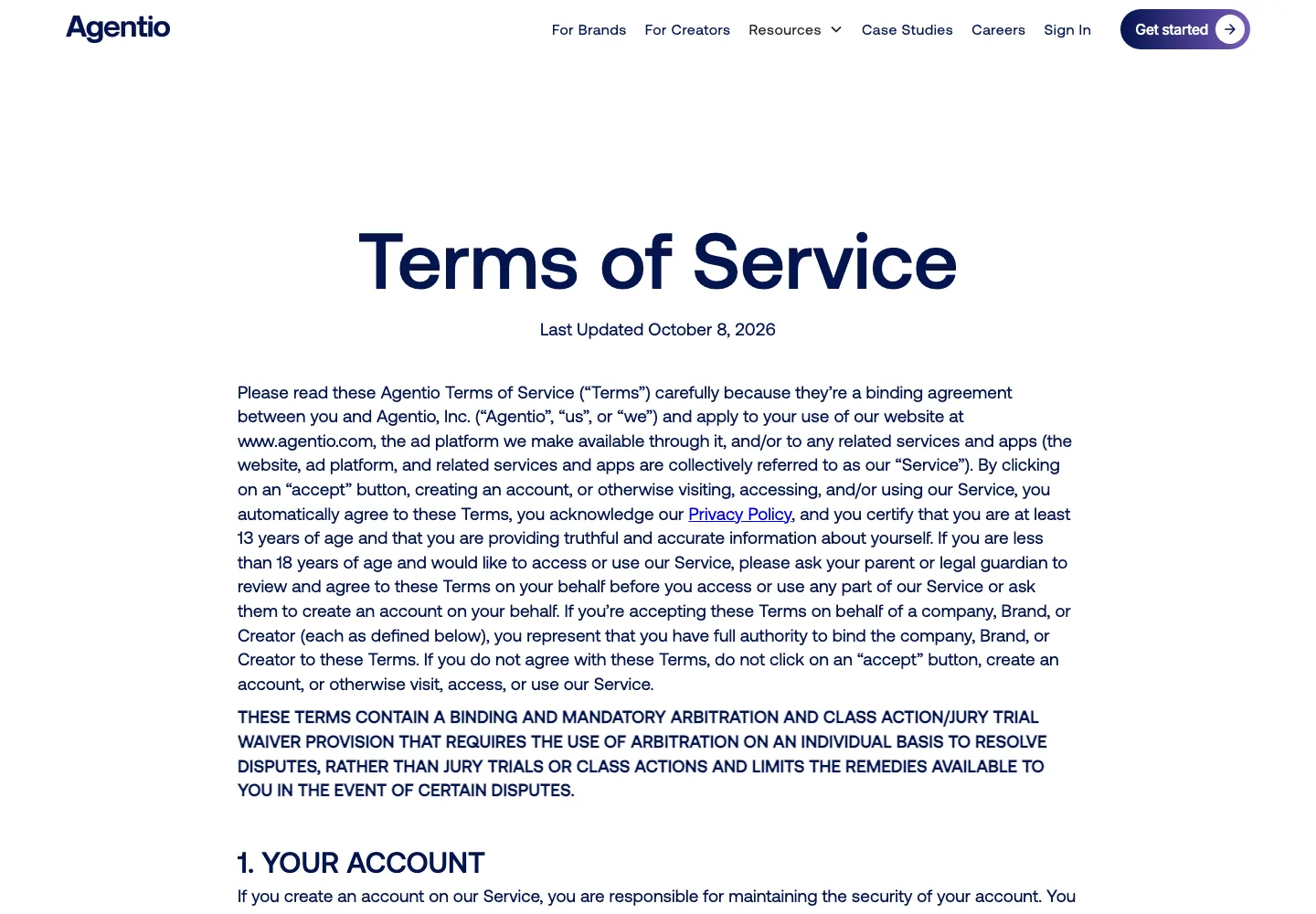
As a brand, you pay the full amount of the bid, and that amount includes the Campaign Fee rather than having it added on top1.
A $5,000 budget produces a $1,000 Campaign Fee and a $4,000 creator bid, and that $4,000 matches Contrary's formula: 100,000 median views at $40 CPM, divided by 1,0007. The terms are the one published source for the 20%, so confirm the fee on your order.
Does Agentio work for TikTok Shop creators?
Agentio's creator page names Instagram and YouTube2. The company launched on YouTube in October 2023 and opened the same workflow on Instagram and Facebook in July 20267. Third-party reports on TikTok conflict: Tano says TikTok and Snap were announced for 20264, while microinfluencers.io says TikTok was not live there as of September 20269. The pages read for this article do not list TikTok for creators.
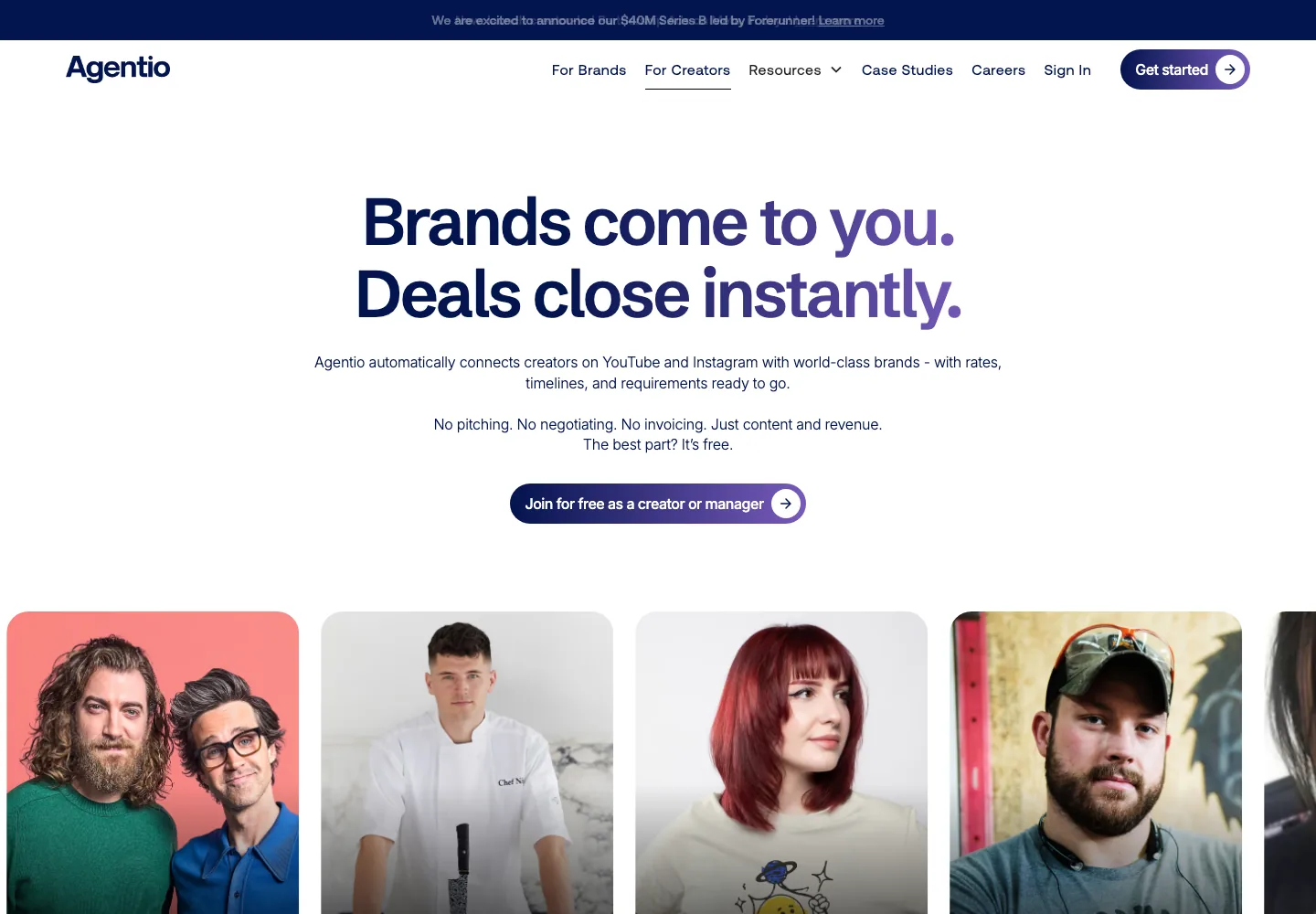
The word "TikTok" does appear in Agentio's terms, but in a different place: brands may run a licensed ad on TikTok and Snapchat ad products as paid advertising1. That is a brand paying to run your YouTube or Instagram ad as a TikTok ad, not you posting TikTok Shop videos. Rateful is built around TikTok Shop creators, so if your income comes from TikTok Shop, that is the platform in this comparison designed around you.
Who should pick Agentio, who should pick Rateful
Agentio fits you if you are a creator on YouTube or Instagram who wants priced offers arriving without pitching or negotiating, at no cost to you2. As a brand, pick it if you have a media budget and want to buy on a CPM basis, including Meta Partnership Ads37.
Pick Rateful if you are a TikTok Shop creator who wants your own rate card enforced. Every deal needs your OK, brand payment is collected before filming starts, and you must be 18 or older in the United States. As a brand, it suits you if you want to book creators on TikTok Shop directly from their public pages at about 5% on top.
If Agentio is close but not right for you, see Agentio alternatives 2026 for brands and creators.
Questions people ask
Is Agentio free for creators?
Yes, Agentio is free for creators and their managers. Joining costs nothing2, and creators receive the full amount of the brand bid they accept. Managers can only help after the creator opens their own account1.
How much does Agentio charge brands?
Agentio charges brands a Campaign Fee of 20% of the total campaign budget. The fee sits inside that budget, so on a $5,000 total budget the Campaign Fee is $1,000 and the creator's bid is $4,00019. Agentio publishes no rate card, so its terms are the only published source for the 20% figure4.
Does Agentio work with TikTok creators?
The creator page lists Instagram and YouTube only2. TikTok was not live on Agentio as of September 2026, per microinfluencers.io9.
Can I negotiate my rate on Agentio?
No, creators cannot negotiate their rate on Agentio. Each offer is priced from audience data and past brand campaigns, and you accept or decline2. Some G2 reviewers mention low rates and awkward negotiation6.
Does Rateful take a cut of my brand deals?
No. Rateful takes 0% of creators' deals, whatever the deal size. Your cost is the monthly plan, and only after the first deal closes: Pro at $49 a month or Scale at $149 a month. On the Free plan you pay nothing at all, though each reply waits for your approval.
Can I use Agentio and Rateful at the same time?
Nothing in the facts reviewed for this page stops a creator from using both. Agentio covers creators on YouTube and Instagram2. One caveat: its creators promise not to contact brands they met through it anywhere else1, so keep the two channels separate.